Fortinet NSE4_FGT_AD-7.6시험패스가능한인증덤프자료, NSE4_FGT_AD-7.6퍼펙트인증덤프자료
Wiki Article
그리고 Itexamdump NSE4_FGT_AD-7.6 시험 문제집의 전체 버전을 클라우드 저장소에서 다운로드할 수 있습니다: https://drive.google.com/open?id=1Su7IxgLeP-XhhwsGzp26D5vNqZvT-Yra
Fortinet인증 NSE4_FGT_AD-7.6시험패스 공부방법을 찾고 있다면 제일 먼저Itexamdump를 추천해드리고 싶습니다. Fortinet인증 NSE4_FGT_AD-7.6시험이 많이 어렵다는것은 모두 알고 있는 것입니다. Itexamdump에서 출시한 Fortinet인증 NSE4_FGT_AD-7.6덤프는 실제시험을 대비하여 연구제작된 멋진 작품으로서 Fortinet인증 NSE4_FGT_AD-7.6시험적중율이 최고입니다. Fortinet인증 NSE4_FGT_AD-7.6시험패스를 원하신다면Itexamdump의 제품이 고객님의 소원을 들어줄것입니다.
Fortinet NSE4_FGT_AD-7.6 시험요강:
| 주제 | 소개 |
|---|---|
| 주제 1 |
|
| 주제 2 |
|
| 주제 3 |
|
| 주제 4 |
|
| 주제 5 |
|
>> Fortinet NSE4_FGT_AD-7.6시험패스 가능한 인증덤프자료 <<
NSE4_FGT_AD-7.6퍼펙트 인증덤프자료, NSE4_FGT_AD-7.6시험패스자료
Fortinet인증NSE4_FGT_AD-7.6시험은 IT인증시험과목중 가장 인기있는 시험입니다. Itexamdump에서는Fortinet인증NSE4_FGT_AD-7.6시험에 대비한 공부가이드를 발췌하여 IT인사들의 시험공부 고민을 덜어드립니다. Itexamdump에서 발췌한 Fortinet인증NSE4_FGT_AD-7.6덤프는 실제시험의 모든 범위를 커버하고 있고 모든 시험유형이 포함되어 있어 시험준비 공부의 완벽한 선택입니다.
최신 Fortinet NSE 4 NSE4_FGT_AD-7.6 무료샘플문제 (Q11-Q16):
질문 # 11
Refer to the exhibit. Why did FortiGate drop the packet?
- A. The next-hop IP address is unreachable.
- B. It matched the default implicit firewall policy.
- C. It failed the RPF check.
- D. It matched an explicitly configured firewall policy with the action DENY.
정답:B
설명:
The debug trace output shows that the packet was "Denied by forward policy check (policy 0)." In FortiGate, policy ID 0 corresponds to the default implicit deny policy. This means that if a packet does not match any configured firewall policies, it is denied by the default implicit policy.
질문 # 12
Refer to the exhibit.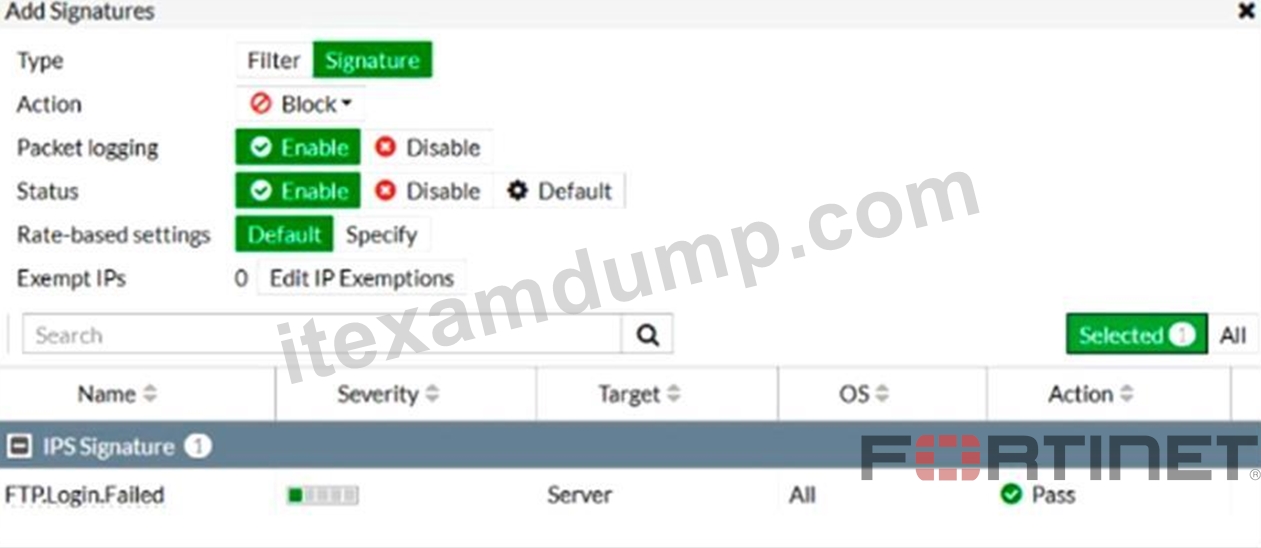
Review the intrusion prevention system (IPS) profile signature settings shown in the exhibit.
What do you conclude when adding the FTP.Login.Failed signature to the IPS sensor profile?
- A. Traffic matching the signature will be allowed and logged.
- B. The signature setting uses a custom rating threshold.
- C. Traffic matching the signature will be silently dropped and logged.
- D. The signature setting includes a group of other signatures.
정답:C
설명:
Select Block to silently drop traffic matching any of the signatures included in the entry.
So, while the default action would be 'Pass' for this signature the administrator is specifically overriding that to set the Block action. To use the default action the setting would have to be
'Default'.
질문 # 13
Refer to the exhibits.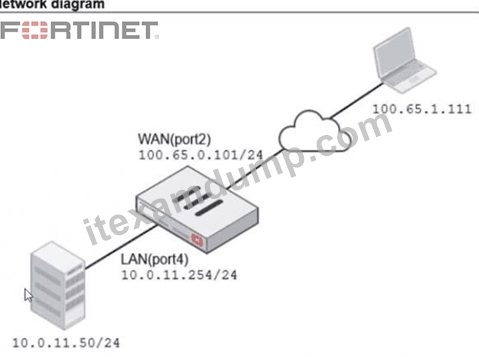
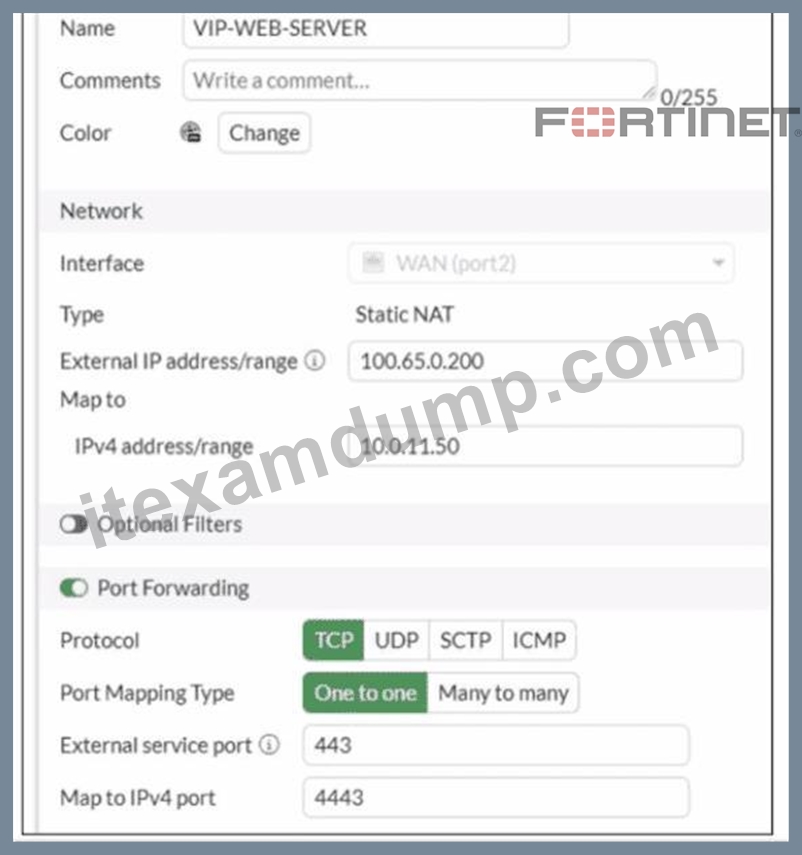

A diagram of a FortiGate device connected to the network VIP object and firewall policy configurations are shown.
The WAN (port2) interface has the IP address
100.65.0.101/24.
The LAN (port4) interface has the IP address
10.0.11.254/24.
If the host 100.65.1.111 sends a TCP SYN packet on port 443 to 100.65.0.200. what will the source address, destination address, and destination port of the packet be at the time FortiGate forwards the packet to the destination?
- A. 10.0.11.254, 10.0.15.50, and 4443. respectively
- B. 100.65.1.111, 10.0.11.50. and 443. respectively
- C. 100.65.1. 111, 10.0.11.50, and 4443. respectively
- D. 10.0.11.254, 100.65.0.200. and 443, respectively
정답:C
설명:
From the exhibits:
A VIP named VIP-WEB-SERVER is configured on WAN (port2) with:
External IP: 100.65.0.200
Mapped (internal) IP: 10.0.11.50
Port forwarding enabled (TCP)
External service port: 443
Map to IPv4 port: 4443
The inbound firewall policy Web_Server_Access is:
From WAN (port2) to LAN (port4)
Destination: VIP-WEB-SERVER
Service: HTTPS
NAT: Disabled (meaning no source NAT is applied)
What happens to the packet
A host 100.65.1.111 sends TCP SYN dst-port 443 to 100.65.0.200.
When FortiGate matches the VIP and forwards traffic to the internal server, FortiGate performs destination NAT (DNAT) based on the VIP:
Source IP is unchanged because policy NAT is disabled:
Source remains 100.65.1.111
Destination IP is translated by the VIP:
Destination becomes 10.0.11.50
Destination port is translated by the VIP port-forward:
Destination port becomes 4443
Therefore, at the time FortiGate forwards the packet to the destination (internal server), it will be:
Source address: 100.65.1.111
Destination address: 10.0.11.50
Destination port: 4443
질문 # 14
Refer to the exhibits.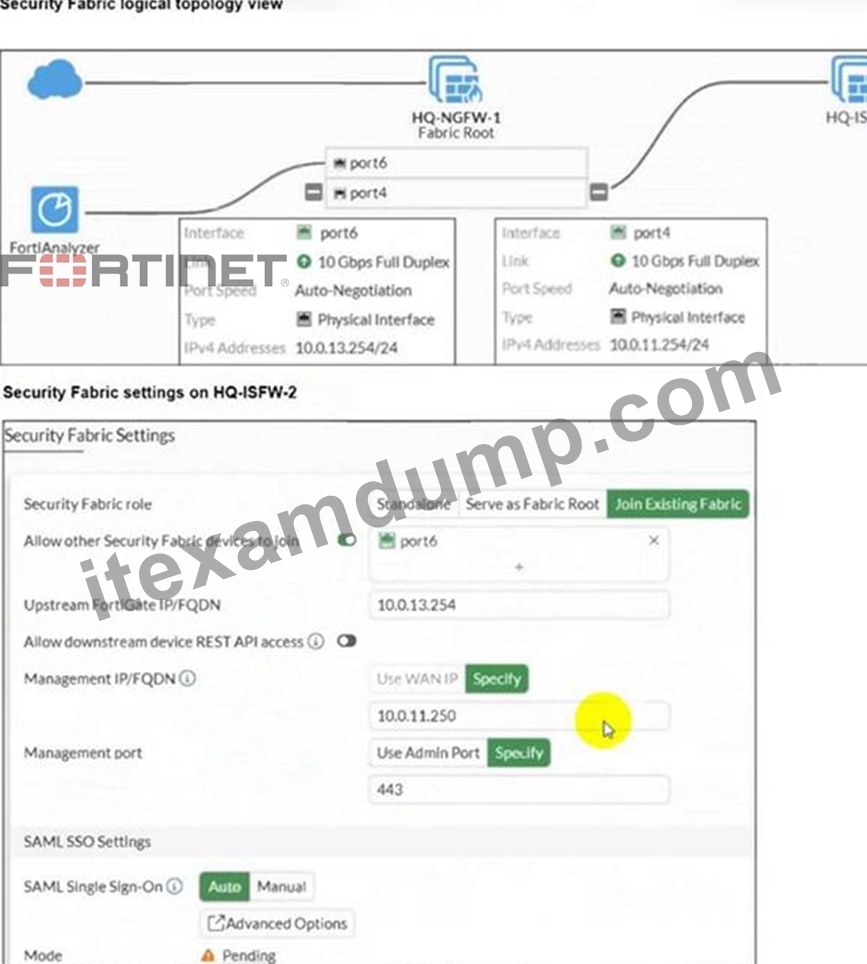
An administrator wants to add HQ-ISFW-2 in the Security Fabric. HQ-ISFW-2 is in the same subnet as HQ-ISFW. After configuring the Security Fabric settings on HQ-ISFW-2, the status stays Pending. What can be the two possible reasons? (Choose two answers)
- A. HQ-ISFW-2 must be authorized on HQ-ISFW.
- B. Management IP must be set to 10.0.13.254.
- C. Upstream FortiGate IP must be set to 10.0.11.254.
- D. SAML Single Sign-On must be set to Manual.
정답:A,C
설명:
According to the FortiOS 7.6 Security Fabric documentation and Study Guide, several conditions must be met for a downstream FortiGate to successfully join a Security Fabric.
First, the Upstream FortiGate IP/FQDN configured on the downstream device must point to the IP address of the interface on the upstream device that is listening for fabric connections. In the provided logical topology, the Fabric Root (HQ-NGFW-1) uses port4 with the IP 10.0.11.254 to connect to the internal segmentation firewalls (ISFWs). Since HQ-ISFW-2 is in the same subnet as HQ-ISFW, it is physically and logically connected to the network segment serviced by port4. Therefore, the current configuration of 10.0.13.254 (which is port6, likely the WAN side) is incorrect, and it must be set to 10.0.11.254 (Statement A).
Second, once the downstream device successfully reaches the upstream device, it enters a Pending state. For security purposes, FortiOS does not allow devices to join the fabric automatically; the administrator of the upstream device (in this case, HQ-ISFW or the root) must manually authorize the new device (Statement C) in the Fabric Management console. Until this authorization is granted, the status will remain "Pending" and no fabric data will be synchronized. Statements B and D are incorrect as SAML settings do not block the initial fabric join, and the management IP should be the local device's IP, not the upstream's IP.
질문 # 15
Refer to the exhibit.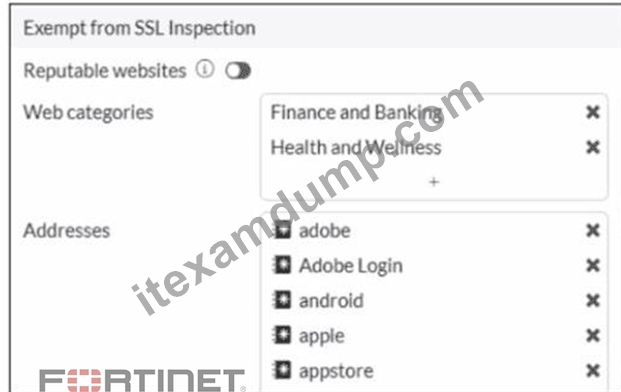
The predefined deep-inspection and custom-deep-inspection profiles exclude some web categories from SSL inspection, as shown in the exhibit For which two reasons are these web categories exempted? (Choose two.)
- A. The legal regulation aims to prioritize user privacy and protect sensitive information for these websites.
- B. These websites are in an allowlist of reputable domain names maintained by FortiGuard.
- C. The resources utilization is optimized because these websites are in the trusted domain list on FortiGate.
- D. The FortiGate temporary certificate denies the browser's access to websites that use HTTP Strict Transport Security.
정답:A,B
설명:
In FortiOS 7.6, the predefined deep-inspection and custom-deep-inspection SSL inspection profiles intentionally exclude certain web categories (such as Finance and Banking and Health and Wellness) and well- known domains (for example, Apple, Google, Adobe). This behavior is documented and intentional.
The two correct reasons are:
B). The legal regulation aims to prioritize user privacy and protect sensitive information for these websites.
Correct
Categories like Finance and Banking and Health and Wellness commonly handle highly sensitive personal data.
Many privacy and compliance regulations (for example, GDPR, PCI-DSS, HIPAA-like requirements) discourage or restrict SSL interception for such traffic.
To reduce legal and compliance risks, FortiOS exempts these categories from deep SSL inspection by default.
This is explicitly stated in FortiOS SSL/SSH Inspection documentation.
C). These websites are in an allowlist of reputable domain names maintained by FortiGuard.
Correct
FortiGuard maintains a reputable/trusted domain list for well-known services and platforms.
These domains are excluded from deep inspection by default to:
Prevent application breakage
Avoid certificate pinning and compatibility issues
Maintain user experience
This is why domains such as Apple, Google, Adobe, and app stores appear under SSL inspection exemptions.
Why the other options are incorrect
A). Resource utilization optimization
Incorrect.
While reduced inspection can save resources, this is not the primary documented reason for exempting these categories.
D). FortiGate temporary certificate denies access to HSTS websites
Incorrect.
Although HSTS and certificate pinning can cause issues with SSL inspection, this option describes a side effect, not the reason for exemption.
The exemption exists to avoid such problems, not because the certificate denies access.
질문 # 16
......
Itexamdump는 전문적인 IT인증시험덤프를 제공하는 사이트입니다.NSE4_FGT_AD-7.6인증시험을 패스하려면 아주 현병한 선택입니다. Itexamdump에서는NSE4_FGT_AD-7.6관련 자료도 제공함으로 여러분처럼 IT 인증시험에 관심이 많은 분들한테 아주 유용한 자료이자 학습가이드입니다. Itexamdump는 또 여러분이 원하도 필요로 하는 최신 최고버전의NSE4_FGT_AD-7.6문제와 답을 제공합니다.
NSE4_FGT_AD-7.6퍼펙트 인증덤프자료: https://www.itexamdump.com/NSE4_FGT_AD-7.6.html
- NSE4_FGT_AD-7.6시험패스 가능한 인증덤프자료 인기자격증 덤프 ???? ☀ www.koreadumps.com ️☀️의 무료 다운로드《 NSE4_FGT_AD-7.6 》페이지가 지금 열립니다NSE4_FGT_AD-7.6인증덤프공부문제
- NSE4_FGT_AD-7.6시험패스 가능한 인증덤프자료 100%시험패스 공부자료 ???? 지금「 www.itdumpskr.com 」에서▷ NSE4_FGT_AD-7.6 ◁를 검색하고 무료로 다운로드하세요NSE4_FGT_AD-7.6인증덤프공부문제
- NSE4_FGT_AD-7.6시험대비 덤프문제 ❎ NSE4_FGT_AD-7.6최신 업데이트버전 시험자료 ???? NSE4_FGT_AD-7.6인기자격증 최신시험 덤프자료 ???? ➤ www.pass4test.net ⮘웹사이트에서⏩ NSE4_FGT_AD-7.6 ⏪를 열고 검색하여 무료 다운로드NSE4_FGT_AD-7.6적중율 높은 덤프자료
- 100% 유효한 NSE4_FGT_AD-7.6시험패스 가능한 인증덤프자료 시험자료 ⬇ 지금▷ www.itdumpskr.com ◁에서✔ NSE4_FGT_AD-7.6 ️✔️를 검색하고 무료로 다운로드하세요NSE4_FGT_AD-7.6적중율 높은 덤프자료
- Fortinet NSE4_FGT_AD-7.6최신버전덤프, 는 모든 NSE4_FGT_AD-7.6시험내용을 커버합니다! ???? 무료 다운로드를 위해 지금➤ www.dumptop.com ⮘에서➤ NSE4_FGT_AD-7.6 ⮘검색NSE4_FGT_AD-7.6최신 시험대비 공부자료
- Fortinet NSE4_FGT_AD-7.6최신버전덤프, 는 모든 NSE4_FGT_AD-7.6시험내용을 커버합니다! ???? 「 www.itdumpskr.com 」은⇛ NSE4_FGT_AD-7.6 ⇚무료 다운로드를 받을 수 있는 최고의 사이트입니다NSE4_FGT_AD-7.6인기자격증 최신시험 덤프자료
- 완벽한 NSE4_FGT_AD-7.6시험패스 가능한 인증덤프자료 인증시험덤프 ⛽ ➠ www.pass4test.net ????에서 검색만 하면▛ NSE4_FGT_AD-7.6 ▟를 무료로 다운로드할 수 있습니다NSE4_FGT_AD-7.6시험대비 인증공부자료
- 시험준비에 가장 좋은 NSE4_FGT_AD-7.6시험패스 가능한 인증덤프자료 최신버전 공부자료 ???? ▶ www.itdumpskr.com ◀을(를) 열고[ NSE4_FGT_AD-7.6 ]를 입력하고 무료 다운로드를 받으십시오NSE4_FGT_AD-7.6시험대비 덤프샘플 다운
- Fortinet NSE4_FGT_AD-7.6최신버전덤프, 는 모든 NSE4_FGT_AD-7.6시험내용을 커버합니다! ☑ ➥ kr.fast2test.com ????을(를) 열고{ NSE4_FGT_AD-7.6 }를 입력하고 무료 다운로드를 받으십시오NSE4_FGT_AD-7.6 100%시험패스 공부자료
- NSE4_FGT_AD-7.6시험패스 가능한 인증덤프자료 시험덤프 샘플문제 다운로드 ☯ ➡ www.itdumpskr.com ️⬅️에서( NSE4_FGT_AD-7.6 )를 검색하고 무료로 다운로드하세요NSE4_FGT_AD-7.6인증덤프문제
- NSE4_FGT_AD-7.6적중율 높은 덤프자료 ???? NSE4_FGT_AD-7.6인증덤프공부자료 ???? NSE4_FGT_AD-7.6인증덤프공부자료 ???? ➥ www.passtip.net ????을 통해 쉽게➡ NSE4_FGT_AD-7.6 ️⬅️무료 다운로드 받기NSE4_FGT_AD-7.6인증시험 덤프공부
- asiyamhie699389.vblogetin.com, lorismyu852953.blogsuperapp.com, lanceulqz588080.bimmwiki.com, testacademia.com, old.mirianalonso.com, webookmarks.com, shaniaekgn904127.blogsumer.com, izaakmuja314668.wikiparticularization.com, www.stes.tyc.edu.tw, heidijcoh735353.kylieblog.com, Disposable vapes
그리고 Itexamdump NSE4_FGT_AD-7.6 시험 문제집의 전체 버전을 클라우드 저장소에서 다운로드할 수 있습니다: https://drive.google.com/open?id=1Su7IxgLeP-XhhwsGzp26D5vNqZvT-Yra
Report this wiki page